by Michelle Lentz
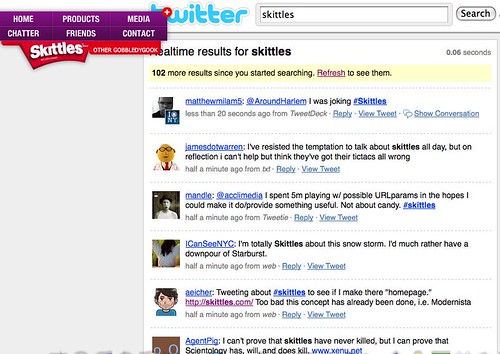
The hot topic on the Interwebs today is Skittles. Go to Skittles.com and you’ll discover that they’ve relinquished control of their web site.

There is a navigation tool that floats and lets you navigate between Chatter, Products, Friends, and more. But each of those goes somewhere interesting: Chatter goes to the Twitter Search page for Skittles (which is also the Skittles.com home page), Products takes you to Wikipedia, and Friends takes you to Facebook. In fact, it seems that only Contact Us takes you to an actual Skittles hosted page.

I’ve read different takes on this all day. I’ve seen people screaming that the economy isn’t that bad and why can’t they hire a web designer. I’ve seen others celebrate the rather, um, ballsy take on a web site. I think I fall somewhere near the middle, leaning more towards ballsy than cheap. I feel like Skittles, in relinquisihing control, has admitted that all of us folks out here on the Web actually have a clue. They’ve taken listening to the consumer to a whole new level. However, I think there needs to be a little more integration of product in there. I suppose you can get that from the Facebook Fan page, with the apps and such, but really – if I’m going to the Skittles web site, I want more information on Skittles (more branding, perhaps) from the company in conjunction with user-generated content.

This type of approach to a web site may fall into the “all publicity is good publicity” category. It seems to have moved past that, but earlier today, the Skittles twitter search was showing some rather crude comments with #Skittles in the text. It currently is showcasing people talking about the web site and or those who are using the Hash Tag for the fun of showing up on the front page. No one is really chatting about the candy. The Wikipedia page focuses on types of flavors, but doesn’t tell you anything really useful about the product. The Facebook Fan page is fun, but again, not useful in a “learn more about the product” kind of way.

The point has been made, repeatedly, that ad agency Modernista did this about a year ago. According to AdAdge.com, however, Skittles is the first consumer product to give this a try. Another quote in that AdAge article struck my fancy (emphasis mine):
An Agency.com spokeswoman said that “Skittles as a brand is all about embracing and empowering the conversation online — just look at the YouTube entries and their Facebook page. Its kind of a natural evolution for them moving in to something like this.”
Now, is that how you think of Skittles? When I think of Skittles, I think of candy that is chewy and turns my tongue colors. I like Skittles’ approach, but I wonder, would it be more effective if they scaled it back a little and still retained of bit of their own content?
What are your thoughts on the new Skittles site?
__
Contact Michelle with news, stories, events, and more.
Email: michelle[at]writetech[dot]net
Twitter: @writetechnology, Friendfeed: michellel
Blogs: Write Technology, Wine-Girl.net

{ 1 trackback }
{ 5 comments }
Michelle,
I agree with this view completely. While it shows Skittles understands the power of conversation and the influencers on Twitter, it completely abandons their brand identity. While I’m all for giving up control, it has to be a controlled experiment (I know). They need to integrate it better with a more social site.
When you really think about it, all they needed to do was take the RSS feed that’s right there on the top corner of the page and push that into a skittles bag. Wouldn’t that have been better?
What’s worse is that the site actually allows you to use it as you would search.twitter.com. While this could add traffic and keep people on their site longer, they are staying there for all the wrong reasons.
Thanks!
DW
Obviously everyone is missing how they are collecting data today. I wrote about it here on siliconANGLE:
http://www.siliconangle.com/technology/skittles-just-social-engineered-you/
I even have some unconfirmed sources that tell me the company that is going to benefit from the data they just had people volunteer so easily today. Like taking candy from a baby.
Rex
I’m a social media saavy person. I love the internet. I spend way too much time on social networks.
That said, I didn’t *get* it when I saw people talking about Skittle’s site change. I didn’t understand what the big deal was or why or why I had to keep putting in my birthdate for a CANDY website.
Maybe if there was some kind of explination saying “hey we’re Skittles and we think the best info out there on the web is from YOU so our site is now… YOU…?”
I was just confused.
I also agree with this tactic, with one rather large caveat. Twitter is for people 18 years of age and older. So does this effort overlook Skittles main consumer base (i.e. kids)?
I had the same thought – concept was fun, got a lot of people over to their site, but totally ignored their actual target market (kids). I also feel pretty bad about all the Twitter action going native (when one or two people add cursewords it’s funny – when hundreds do, well, that’s just mean.) But if you think about “any publicity is good publicity” it was totally successful – even Motrin are probably pretty happy about all the free press they got even if it was backlash.
Comments on this entry are closed.